

Which figurines increase in value over time?
Some figurines remain beautiful objects that we enjoy looking at. Others gradually become true collector’s items—more sought-after, harder to find, and sometimes more coveted than when they were first released. It’s never automatic. A figurine doesn’t gain value simply because it’s made of resin, is large, or is painted. The collectors’ market is more nuanced than that.
What matters is a combination of factors: the quality of the sculpture, its rarity, its condition, its finish, its scale, the piece’s overall coherence, and its traceability. And in this regard, the certificate of authenticity plays a crucial role.
When you buy a collectible figurine, you’re not just buying a beautiful piece. You’re also buying a story, a history, a piece of evidence—an object that you can clearly identify over time.

The value of a figurine is never determined by a single factor
Rarity naturally attracts collectors
A figurine that’s easy to find anywhere will have a harder time increasing in value. Conversely, a piece produced in small quantities, made to order, or hard to find may become more appealing to a collector.
Rarity does not mean that a piece will necessarily become valuable. It simply means that it may become more desirable if there is demand for it. A rare figurine that is not highly regarded will remain obscure. A rare figurine that is well-sculpted, has a real presence, and features a beautiful finish will have more going for it.
That is why the concept of rarity must always be linked to quality. A limited-edition piece that is visually unremarkable is not enough. A piece that is striking, expressive, well-documented, and hard to come by is more likely to retain its appeal.
The quality of the carving remains the foundation
A beautiful figurine starts with a good sculpture. The facial details, posture, textures, proportions, base, and silhouette all matter greatly. A piece that stands the test of time is often one whose sculpture remains clear and recognizable, even several years after purchase.
Resin figurines have an interesting advantage: they can highlight very fine details. Leather, skin, metal, hair, scales, fabric, stone, armor, weapons, accessories… all of these elements add depth to the figurine.
A figurine with poor sculpting may be appealing at first glance thanks to a beautiful photograph or an eye-catching painting. But over time, it is often the proportions and the quality of the sculpting that endure. Experienced collectors look beyond the immediate impression.
The universe must speak to a community
A figurine is more likely to increase in value if it belongs to a popular genre. Fantasy, dark fantasy, science fiction, manga, mythology, historical, warriors, creatures, soft pin-ups, or horror: every genre has its own collectors.
Some pieces become sought-after because they perfectly capture a certain atmosphere. A fantasy warrior with a powerful silhouette, a dark and highly expressive creature, or a large mythological piece may appeal to different collectors, but for the same reasons: they tell a story.
A figurine with a distinct identity will be more appealing, easier to recognize, and more memorable. A piece that is too generic—even if it is well-made—risks blending in with the crowd.
The Certificate of Authenticity: A Decisive Factor in Value
Without a certificate, a figurine loses part of its history
The certificate of authenticity isn’t just a piece of paper thrown into the box. For a collector, it’s proof. It links the figurine to its origin, its production, the store where it was purchased, its edition, or the order under which it was made.
Even without a certificate, a figurine can still be beautiful. But it becomes harder to identify. Where does it come from? When was it produced? Is it indeed the version advertised? Is it a complete piece? Does it have an unpainted or originally painted finish? These questions can become important if the figurine is resold, passed on, or added to a serious collection.
A certificate of authenticity lends weight to the object. It transforms a single figurine into a documented piece. And in the world of collecting, documentation matters almost as much as the object itself.
The certificate provides reassurance to current and future collectors
A buyer who receives a figurine with a certificate knows that they own an identifiable piece. It’s not just a sculpture displayed in a showcase. It’s a piece that comes with proof of authenticity.
This proof also reassures a potential future buyer. If the figurine ever changes hands, the certificate helps dispel some doubts. It can confirm the piece’s origin, nature, finish, or connection to the shop that produced it.
This is particularly important for resin figurines, as many items are sold online without clear context. A nice photo isn’t always enough. A well-preserved certificate of authenticity provides reliable information, whereas ads, descriptions, and memories can fade away.
A well-preserved certificate must remain with the figurine
The certificate of authenticity must be kept in good condition. Do not throw it away, fold it carelessly, or permanently separate it from the figurine. Ideally, it should remain in the box, in a sleeve, or in a folder dedicated to the collection.
For a collectible item, the set includes: the figurine, the base, any additional pieces, the packaging (if available), and the certificate. The more complete the set, the more valuable the item is in the eyes of a collector.
A figurine without a certificate may still have sentimental or aesthetic value. But a figurine with a certificate—one that is well-preserved and well-documented—inspires greater confidence. And confidence directly influences perceived value.
The figurines that retain their appeal the best
Large-scale projects have a more lasting impact
1/9, 1/6, and 1/4 scale figures do not have the same impact. Larger scales often have a stronger presence, especially when they are well-sculpted and well-displayed.
A 1/9-scale figurine can still be easy to display in a showcase. It’s ideal for extensive collections and for enthusiasts who like to arrange multiple pieces together. The 1/6 scale often strikes a great balance: large enough to show off the details, yet still manageable to display.
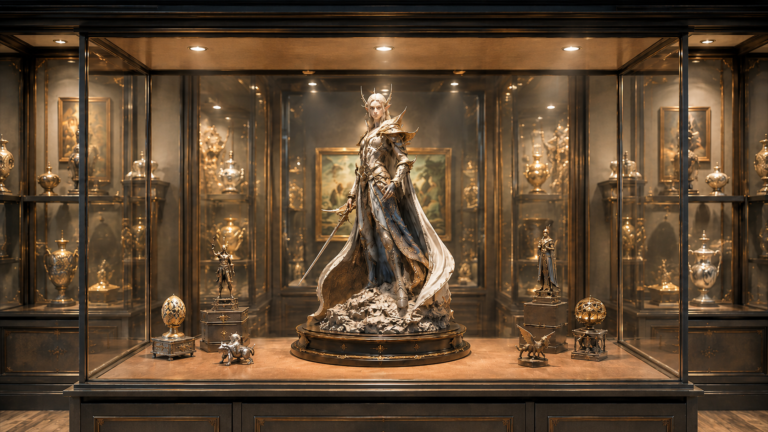
The 1/4 scale is more imposing. It can become a real centerpiece in a collection. This scale often appeals to enthusiasts of more prominent sculptures—almost like display pieces. But it also requires better condition, a sturdy finish, and a suitable location.
A large figurine does not automatically increase in value. But if it is well-made, rare, in good condition, and comes with a certificate of authenticity, it has more going for it.
Painted figurines can be appealing because of their finish
A painted figurine can have special value, especially if the coloring is done with care. The paint brings the shapes to life, distinguishes between materials, enhances facial expressions, and makes the piece immediately recognizable.
But a paint job must age well. A finish that is too flashy, too fragile, or too far removed from the spirit of the sculpture may lose its charm over time. Conversely, a balanced, clear, and cohesive paint job can make a figurine more desirable.
A well-preserved, undamaged painted figurine—one that hasn’t been clumsily repainted—and comes with its certificate of authenticity will always be more reassuring. The certificate helps you better understand what you own: a painted piece, a selected version, or a part of a continuous production run.
Unpainted miniatures appeal to painters and purists
An unpainted figurine can also be quite fascinating. It appeals to painters, sculpture enthusiasts, and collectors who enjoy seeing the forms without the influence of color.
The unpainted version has one advantage: it offers complete freedom. A collector can decide to paint it later, have it painted by an artist, or keep it as a sculpture. In some cases, a rare, intact unpainted figurine can be highly sought after, precisely because it has not been altered.
Here again, the certificate of authenticity is important. It allows the piece to be clearly identified, even without paint. It confirms that the figurine is not just an anonymous cast, but a piece linked to a specific production run.
What Can Cause a Figurine to Lose Value
Visible damage
A collectible figurine must be handled with care. A broken tip, a bent weapon, a cracked base, chipped paint, or a missing part can greatly reduce its value.
Resin figurines can be highly detailed, but certain delicate elements remain fragile: fingers, blades, strands of hair, wings, horns, and accessories. It is often these details that give the piece its presence. When they are damaged, the overall quality suffers.
Storing a figurine in a suitable display case, protected from impacts, excessive dust, and harsh light, helps preserve its condition.
The lack of evidence or documentation
A figurine without a certificate of authenticity, clear information, a known origin, or proof of purchase is harder to value. It may be beautiful, but it requires more trust on the buyer’s part.
In a serious collection, documentation helps avoid any ambiguity. The certificate of authenticity, order information, original photos, the box, and any items included with the figurine all contribute to this clarity.
This is even more true in a market where many figurines are available online. Without proof, a piece can be mistaken for a copy, a modified version, an undocumented print, or a piece of uncertain origin.
Changes That Were Not Properly Managed
Painting an unpainted miniature can make it more appealing if the work is done well. But a poorly executed paint job, a visible repair, or a major modification can have the opposite effect.
Collectors often prefer pieces that are consistent. A modification can be beautiful if it’s well thought out. But it must respect the sculpture, the theme, and the overall finish. A clumsy alteration quickly catches the eye.
If a figurine is modified, it’s helpful to keep before-and-after photos and clearly indicate what was done. Transparency builds trust.
Figurine Workshop: Choosing a Piece with True Traceability
At Atelier Figurines, a custom-made resin figurine is conceived as a collector’s item, not merely as a decorative object. Scale, finish, sculpting, display appeal, and traceability are all important factors.
The certificate of authenticity is a key element in this process. It accompanies the piece, confirms its origin, and provides the collector with a record to keep. For a figurine you intend to keep for a long time, this detail is far from trivial.
The unfinished and painted finishes cater to two different approaches to collecting. The unfinished finish may appeal to painters and lovers of pure sculpture. The painted finish is ideal for those who want a piece that’s ready to display, with volumes and details that are immediately apparent.
Large scales, such as 1/9, 1/6, and 1/4, allow you to choose the desired level of presence. A larger piece often attracts more attention, but it also requires more space and more care.
The goal is not to promise a guaranteed increase in value. No one can seriously guarantee that. Rather, the goal is to choose a figurine based on the right criteria: quality, consistency, condition, finish, certificate of authenticity, and lasting enjoyment.
Conclusion
The figurines that increase in value over time are not simply the largest, most expensive, or most spectacular ones. They are often those that combine several qualities: strong sculpting, a consistent finish, a real presence, relative rarity, good condition, and clear documentation.
The certificate of authenticity plays a central role here. It establishes the piece’s identity. It reassures the collector. It accompanies the figurine over time. Without it, a piece may still be beautiful, but it loses some of its traceability.
Buying a collectible figurine, then, means choosing with pleasure, but also with a systematic approach. There’s no guarantee that a piece will increase in value. However, you can choose a figurine that’s more likely to remain desirable: one that’s well-sculpted, well-preserved, well-documented, and accompanied by a certificate of authenticity.
FAQ
Yes, that can happen, but it’s never guaranteed. The value depends on several factors: rarity, quality of the sculpture, condition, finish, collector demand, and traceability. A well-preserved figurine that is hard to find and comes with a certificate of authenticity will generally be more valuable than an anonymous piece with no proof of origin. However, you should buy a figurine first and foremost because you like it, not just as an investment.
The certificate of authenticity establishes the figurine’s identity. It helps prove its origin, nature, and connection to the manufacturer or store. For a collector, it’s a source of confidence. If the figurine is resold or passed on, the certificate reassures the future buyer. A piece without a certificate may still be beautiful, but it becomes harder to document and is therefore sometimes less attractive.
Not always. A painted figurine may be more desirable if the paint job is meticulous, consistent, and well-preserved. But an unpainted figurine can also be of great interest to painters or collectors who enjoy customizing their pieces. The value depends on the buyer’s profile. In both cases, the certificate of authenticity remains important, as it confirms the piece’s origin and enhances its traceability.
Avoid impacts, excessive dust, humidity, direct heat, and harsh light. A closed display case provides better protection for the piece. It is also advisable to keep the certificate of authenticity, any items included with the figurine, and, if possible, the original packaging. A figurine that is complete, clean, undamaged, and well-documented will always be more appealing to a collector.
Large figurines may be more sought after if they are well-sculpted, rare, accurate, and easy to identify. A 1/6-scale or 1/4-scale piece often has more visual impact than a smaller one. But size alone isn’t enough. A large figure that is poorly preserved, lacks a certificate of authenticity, or is difficult to display may lose its appeal. Overall quality remains more important than size alone.